Tell us about the job
Takes about a minute. No obligation.
Sizing a furnace for Essex County starts with understanding how much the burner and heat exchanger are actually asked to do. Homes in Essex County, VT run heat about ten months a year, from September through June. A system that is undersized runs longer cycles to meet demand, and the ignition system trips more often, putting stress on the components that are hardest to replace. A contractor quoting an install here has to establish the real heat load for the house before specifying equipment, because an error in that calculation does not stay hidden long when the burner almost never gets a rest.
Existing ductwork is what decides how a furnace installation goes in Essex County, and it is decided before the new unit is ever ordered. Half the homes in Essex County, Vermont were built in 1973 or earlier (2020-2024 ACS 5-year). A house built for an earlier generation of heating equipment carries duct runs sized to that system's airflow, and a modern furnace draws differently enough that a contractor has to measure what is there before committing to a configuration. If the ductwork cannot carry the new system's output, it gets modified or replaced, and that work sets the scope and the price more than the furnace itself does.
What a Furnace Installation Puts in Your Home
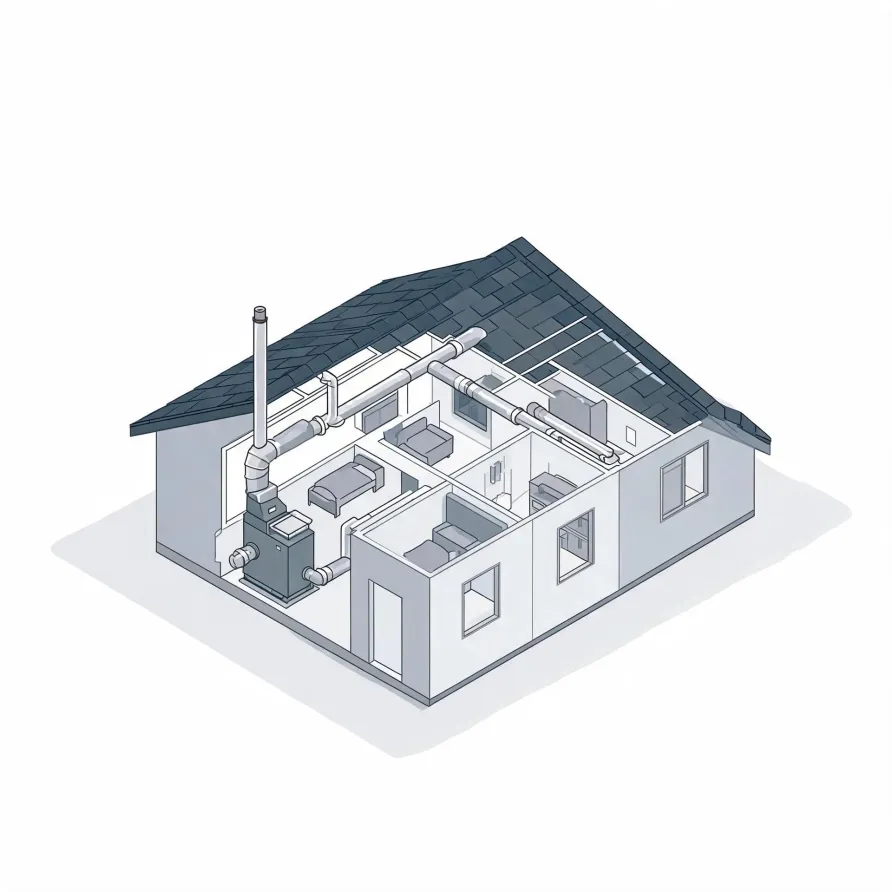
The furnace itself sits in a utility space, basement, or mechanical room and is the unit that produces heat for the house. A burner assembly inside it ignites the fuel, and a heat exchanger transfers that warmth to the air moving through. The flue pipe runs from the unit to an exterior vent, carrying combustion gases out of the home.
The blower fan sits inside the furnace cabinet and pushes conditioned air into the duct system once the heat exchanger is up to temperature. The thermostat mounts on an interior wall and is the control point the homeowner uses every day. A contractor also connects the gas line and the condensate drain where the equipment requires it.
The drawing shows a representative layout, and a licensed contractor determines exactly which components and configurations apply to your house.
Find a contractor in Essex CountyEssex County, Vermont, by the numbers
76 severe weather events were recorded in Essex County, Vermont between 2015 and 2024.
NOAA National Centers for Environmental Information, Storm Events Database, bulk CSV export, events 2015-01-01 through 2024-12-31.Half the homes in Essex County, Vermont were built in 1973 or earlier (2020-2024 ACS 5-year).
U.S. Census Bureau, 2020-2024 American Community Survey 5-Year EstimatesEssex County, Vermont holds 4,952 housing units (2020-2024 ACS 5-year).
U.S. Census Bureau, 2020-2024 American Community Survey 5-Year EstimatesOwners occupy 82.4% of the occupied homes in Essex County, Vermont (2020-2024 ACS 5-year).
U.S. Census Bureau, 2020-2024 American Community Survey 5-Year EstimatesFurnace Installation Rules for Essex County, Vermont6 sourced standards and codes
What the installation actually looks like
Non-weatherized gas furnaces manufactured on or after November 19, 2015 must reach 80.0 percent AFUE.
Non-weatherized oil-fired furnaces manufactured on or after November 19, 2015 must reach 83.0 percent AFUE.
Mobile home gas furnaces manufactured on or after November 19, 2015 must reach 80.0 percent AFUE.
Non-weatherized gas furnaces manufactured on or after December 18, 2028 must reach 95.0 percent AFUE, up from the 80.0 percent minimum that applies to units manufactured before that date.
Licensing Rules for HVAC Work in Essex County, Vermont
Vermont splits the trade across two specialty licences and a contractor may hold one without the other: field A1 covers automatic gas or oil heating including geo-thermal and ground source heat pumps, and field C3 covers refrigeration or air conditioning including air-to-air heat pumps.
Vermont reaches HVAC work through its electricians’ licence rather than an HVAC licence, and the requirement stops at the front door of a house: anyone performing electrical work in Vermont must be licensed as an electrician unless the work is in a residential building containing two or fewer dwelling units.
Severe Weather in Essex County, Vermont
Heating equipment in Vermont works against the weather, and the weather here is not the same from year to year. How hard a furnace has to work, and how long it lasts, depends in part on what the local climate actually delivers.
76 severe weather events, 2015–2024. Source: NOAA National Centers for Environmental Information, Storm Events Database.